

 Code 3 Lead
 Code 4 Lead
 Code 5 Lead
 Code 6 Lead






Rolled Lead Sheet UK: Buy Online in Code 3, 4, 5, 6, 7 & 8
Looking for rolled lead sheet UK supply you can rely on? The Lead Lads Shop offers rolled lead sheet manufactured to BS EN 12588, with popular codes, widths and roll lengths available for flashings, valleys, gutters, dormers, bays and heritage leadwork across the UK.
Whether you need a single roll for a repair or trade quantities for a larger roofing package, this page is designed to help you compare lead codes, choose the right thickness and order the correct accessories for long-lasting leadwork.
For roofers, builders, conservation contractors and homeowners, buying rolled lead sheet UK stock online should be practical and technically informed. This page brings together product guidance, common applications, installation considerations and project imagery so that the material you choose is better matched to the job in hand.

Rolled lead sheet UK: quick buying overview
Rolled lead sheet UK buyers usually need three things: the correct code, the right width and confidence that the material is suitable for the detail being formed. Rolled lead sheet manufactured to BS EN 12588 provides a consistent, milled product suitable for high-quality leadwork including flashings, bays, valleys, gutters, dormers, parapets and other traditional roofing details.
On this page you can compare common lead codes, review thickness and weight guidance, identify popular uses and browse the accessories often needed to complete a professional installation. This makes it easier to buy rolled lead sheet UK stock online without relying on vague product listings or generic merchant descriptions.
Because leadwork is detail-led, the buying process should never be separated from the application. Chimney flashings, abutments, dormer cheeks, secret gutters, parapet gutters and curved bay roofs all place different demands on the lead sheet being used. That is why choosing the correct code and width matters just as much as the product being available to order online.
Which code of rolled lead sheet do I need?
The right code depends on the application, exposure, bay size and required durability. Across the rolled lead sheet UK market, Code 4 and Code 5 are among the most commonly used for roofing details, but lighter and heavier codes have their place depending on the job.
In simple terms, lighter codes are suited to lighter formed details such as soakers and more modest flashings, while heavier codes are reserved for wider weatherings, parapet gutters, valleys, flat bays and areas where increased rigidity or durability is beneficial. The detail itself should always lead the specification. It is rarely enough to choose by price alone.
Code 3 (1.32mm) — soakers and lighter flashings
Code 3 lead is commonly used for soakers and lighter flashings where flexibility and lower weight are beneficial. It is a practical choice for many slate and tile detailing applications.
Where the formed detail is small and movement is well controlled, Code 3 can be an economical and appropriate solution. It is frequently used by contractors who need reliable soakers in standard widths for pitched roofing work.
Code 4 (1.80mm) — the standard choice for many flashings and chimneys
Code 4 is often the go-to specification for step flashings, cover flashings and chimney aprons. For many buyers of rolled lead sheet UK stock, this is the most familiar and widely used code because it balances workability and durability.
It is particularly popular for stepped abutments and chimney work because it is substantial enough for exposed roof detailing while still being practical to dress and form on site. For many traditional repairs, extensions and re-roofing jobs, Code 4 remains the benchmark material.
Code 5 (2.24mm) — valleys, weatherings and heavier duty applications
Code 5 lead is frequently chosen for valleys, aprons, wider weatherings and areas with higher exposure. It offers more rigidity than Code 4 and is a popular upgrade where a more robust sheet is preferred.
It is also widely used where leadwork needs to cope with more demanding shaping, broader spans or increased exposure. For dormer cheeks formed in welted panels, Code 5 is a very common choice because it offers the balance needed between durability and forming performance.
Code 6 to Code 8 — flat roofing, parapets, gutters and larger bays
Heavier codes such as Code 6, 7 and 8 are suited to flat leadwork, parapet gutters, large bays and more exposed detailing. These applications require careful attention to movement, bay sizes, joints and fixing methods.
As sheet size and exposure increase, detailing becomes more critical. Leadworkers must consider expansion, clipping, bay arrangement and lap formation carefully. These heavier gauges are chosen because the application demands them, not simply because thicker always seems better.
Popular widths, lengths and coverage
We stock popular widths such as 150mm, 240mm, 300mm, 450mm and 600mm in practical roll lengths for a wide range of roof details. Narrower widths are often suitable for flashings and step work, while wider rolls are commonly used for valleys, gutters and larger lead bays.
If you are buying rolled lead sheet UK stock for chimneys, dormers or bay tops, always allow for the formed shape, laps, drips, welted edges and any chase depth or upstand needed in the finished detail.
The visible face of a flashing or panel is only part of the equation. Buyers should also allow for concealed parts of the detail, cover into chases, drips at lower edges, turned tops and any allowance needed for standing welts or clips. This is one reason why technical guidance on the product page adds real value to the buying process.
Coverage tips: choosing width, laps and formed details
- Allow for upstands, laps and drips rather than ordering only to visible width.
- Valleys need suitable width for water flow as well as side laps and edge detailing.
- Wider leadwork areas should be designed to accommodate thermal movement correctly.
Code thickness and weight table
Approximate values for BS EN 12588 rolled lead sheet:
| Code | Nominal thickness (mm) | Weight (kg/m²) | Typical uses |
|---|---|---|---|
| Code 3 | 1.32 | ~14.97 | Soakers, lighter flashings |
| Code 4 | 1.80 | ~20.41 | Step flashings, cover flashings, chimney aprons |
| Code 5 | 2.24 | ~25.40 | Valleys, aprons, weatherings, moderate gutters |
| Code 6 | 2.65 | ~30.05 | Parapet gutters, wider flashings |
| Code 7 | 3.15 | ~35.72 | Flat bays, heavier duty gutters |
| Code 8 | 3.55 | ~40.26 | Large bays, exposed flat leadwork |
Common applications and project types
One of the biggest reasons people search for rolled lead sheet UK suppliers is because the material is still the trusted choice for a broad range of roof details. It performs well on both contemporary and traditional buildings, and when correctly detailed it offers a combination of longevity, workability and visual quality that is hard to match.
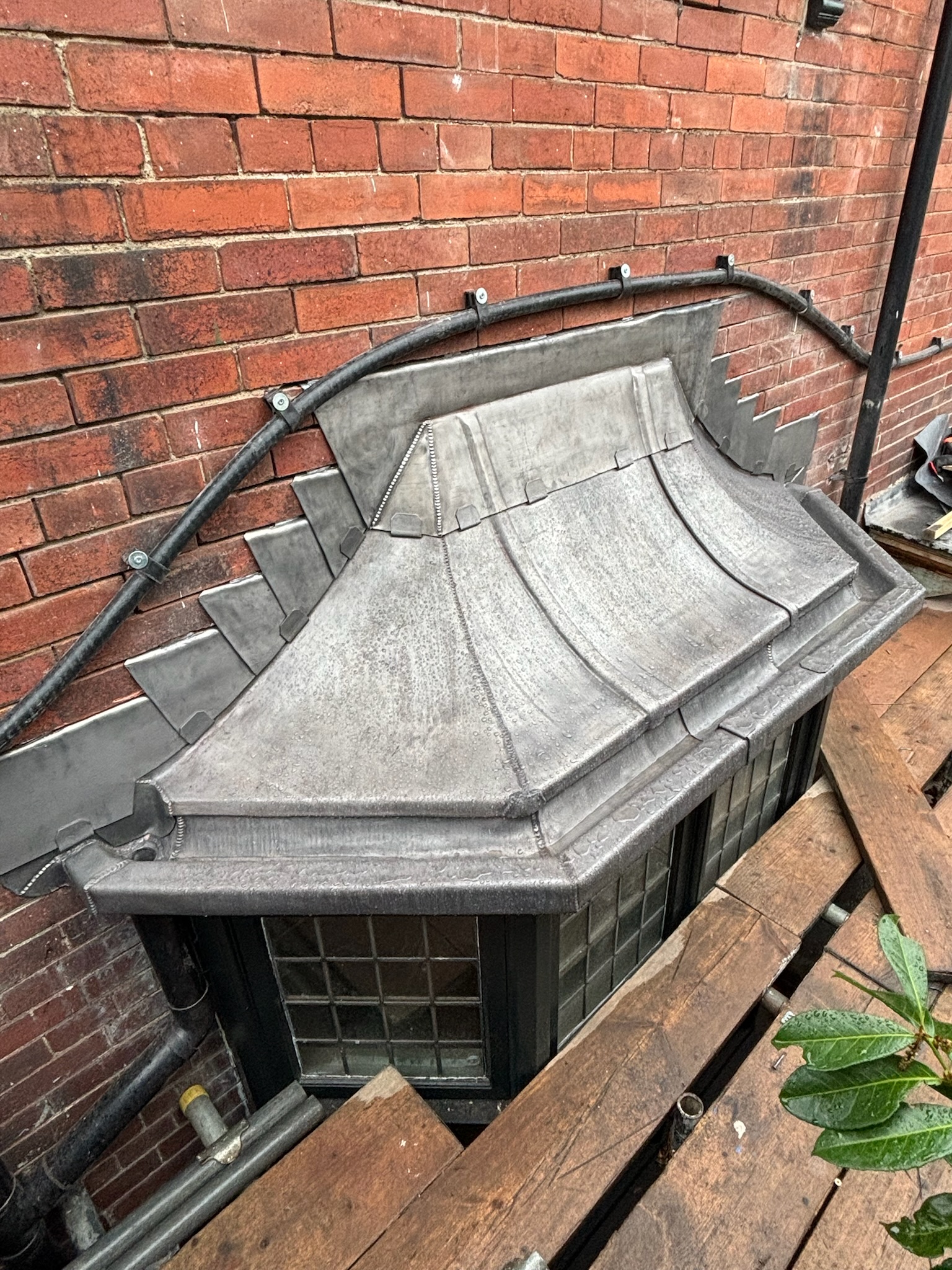
Typical applications include chimney step flashings, cover flashings, apron flashings, secret gutters, parapet gutters, valley gutters, dormer tops, dormer cheeks, bay roofs and formed weatherings. It is also used extensively in conservation work, where the appearance, detailing tradition and service life of the material are especially important.
On heritage properties, lead remains a natural choice because it can be dressed and shaped to suit irregular masonry, curved details and traditional roof forms. On newer buildings, it is equally valuable for providing durable junctions and crisp, purposeful detailing to abutments, bays and chimney penetrations.
For roofers and surveyors, the benefit of a strong rolled lead sheet UK supply page is that it bridges specification and procurement. Instead of reading generic product copy and then having to interpret applications separately, the customer gets both practical product access and the technical context needed to make a better decision.
Essential accessories for a long-lasting finish
Good leadwork depends on more than the sheet itself. If you are ordering rolled lead sheet UK stock for a roofing job, it makes sense to buy the correct accessories at the same time to achieve a cleaner finish and better long-term performance.
Patination oil helps to reduce white carbonate staining. Copper nails provide corrosion resistance. Clips help control and restrain free edges where the detail requires it. Underlay or geotextile can help reduce underside corrosion risk and support a cleaner interface with the substrate. These supporting products are a routine part of proper leadwork rather than optional extras.
Patination oil — reduce white staining
Patination oil should be applied after fixing to help reduce white carbonate staining and improve the appearance of new leadwork.
It is especially useful where lead discharges onto visible slates, tiles or walling below, because untreated new lead can leave staining that detracts from an otherwise high-quality job.
Fixings, clips and underlay
- Copper Nails for corrosion resistance and reliable fixing
- Lead and PVCu Hall Clips to help control movement
- Underlay and geotextile to reduce underside corrosion risk
Matching accessories to the detail makes installation more efficient and improves the finished result. On larger or more exposed work, those supporting components are often just as important as the lead sheet itself.
Lead tools — bossing, dressing and forming
Use the right lead tools for sharper arrises, cleaner detailing and more controlled forming on site.
A well-chosen set of dressers, mallets, wedges and forming tools helps contractors achieve neater work with less risk of damage to the sheet during installation.

Rolled lead sheet UK installation, heritage work and expert support
The best results come from correct bay sizes, suitable laps, proper fixings and movement allowance. For more demanding details, traditional roofs or listed buildings, specialist installation knowledge matters just as much as product quality.
If you are buying rolled lead sheet UK stock for a heritage project, dormer top, curved bay or complex junction, it is worth pairing the correct material with experienced leadwork support.
This is particularly important on traditional buildings, where the leadwork has to do more than simply keep water out. It must also sit comfortably within the roofscape, respect original detailing and perform over the long term without avoidable failure from over-sized bays, poor clipping, weak lap design or unsuitable code choice.
Buyers who understand the installation context generally make better product choices. That is why a strong commercial landing page for rolled lead sheet UK stock should include practical installation notes, common applications and real project references rather than just a list of products.
Buying rolled lead sheet UK stock online
Buying rolled lead sheet UK stock online should be straightforward when the page gives you the right technical context. The key is to match the lead code, width and intended use before ordering, rather than choosing purely by price or roll size. This is especially important for roof flashings, valleys, dormers, parapet gutters and other details where durability and movement allowance matter.
The Lead Lads Shop is designed to make rolled lead sheet UK ordering more practical for trade buyers, specialist contractors and property professionals. By combining clear code guidance, useful accessories and real project imagery, the page helps customers choose with more confidence and buy more accurately.
A good buying page does more than rank for the term. It should help the user get the specification right, reduce uncertainty during checkout and support repeat purchasing for similar details on future projects. That is exactly the role this page is intended to perform.
Rolled lead sheet UK — FAQs
Is rolled lead sheet the same as milled lead?
Yes. Rolled lead sheet is often referred to as milled lead and is manufactured to BS EN 12588 for consistent thickness and predictable performance.
What code of lead is best for chimney flashings?
Code 4 is the most common choice for many chimney step flashings, cover flashings and aprons, subject to the specific detail and exposure.
Which code should I use for valleys?
Code 5 is frequently used for valleys due to its strength and durability, though the final width and specification should suit the water flow and detail design.
Do I need patination oil on new lead?
Patination oil is strongly recommended on new leadwork to reduce white staining and improve the finished appearance.
How is rolled lead sheet delivered in the UK?
Delivery may be by courier or pallet depending on roll size, weight and quantity. Shipping options are usually shown at checkout.
Can you help with installation or heritage leadwork?
Yes. For installation support visit The Lead Lads. For traditional and heritage applications see Neal Roofing’s heritage leadwork page.
This guidance is general and should not replace project-specific design, specification or current leadwork standards. When selecting rolled lead sheet UK stock, always follow the relevant installation guidance, manufacturer information and project documents.