

 Code 3 Lead
 Code 4 Lead
 Code 5 Lead
 Code 6 Lead







Code 8 Lead: 7 Ultimate Heavy-Duty Uses (BS EN 12588)


Code 8 Lead: 7 Ultimate Heavy-Duty Uses (BS EN 12588)
Code 8 lead is the heaviest commonly specified rolled lead sheet in roofing—designed for monumental gutters, deep parapet channels and heritage roofs where there is no appetite for compromise. This guide explores seven ultimate heavy-duty uses for code 8 lead, how to design bays and supports for the extra mass, and how to turn drawings into a clean, compliant order using our Shoppable Lead Chart.
For regulation and best-practice context, review Neal Roofing’s BS 6915 leadwork overview and their Leadwork Services.
In this guide
- Why code 8 lead exists – and when to use it
- 7 ultimate heavy-duty uses for code 8 lead
- Code 7 vs code 8 lead: which is right for your gutter?
- Bay sizing, support design & fixings for extreme gauges
- Design workflow for monumental gutters & parapets
- Heritage and cathedral-grade roofing projects
- Handling, manual lifting & COSHH for code 8
- Fast ordering workflow with the Shoppable Lead Chart
- FAQs about code 8 lead
Why code 8 lead exists – and when to use it
Code 8 lead is a very heavy gauge sheet, with a nominal thickness of around 3.55 mm and a mass in the region of 40 kg/m², manufactured in accordance with BS EN 12588. It occupies a specialist niche at the top of the rolled lead range, offering maximum mass and stiffness where gutters, parapets or heritage roofs must cope with exceptional loads or where access for remedial works is extremely constrained.
In practice, that means code 8 lead is not a general-purpose material. It is reserved for monumental gutters, parapet troughs on very large roofs, cathedral-grade details and high-risk interfaces sitting over particularly sensitive interiors. When you need a specification that pushes towards the upper end of performance while remaining within recognised good practice, this is the gauge that enters the conversation.
7 ultimate heavy-duty uses for code 8 lead
1) Monumental perimeter and parapet gutters on very large roofs
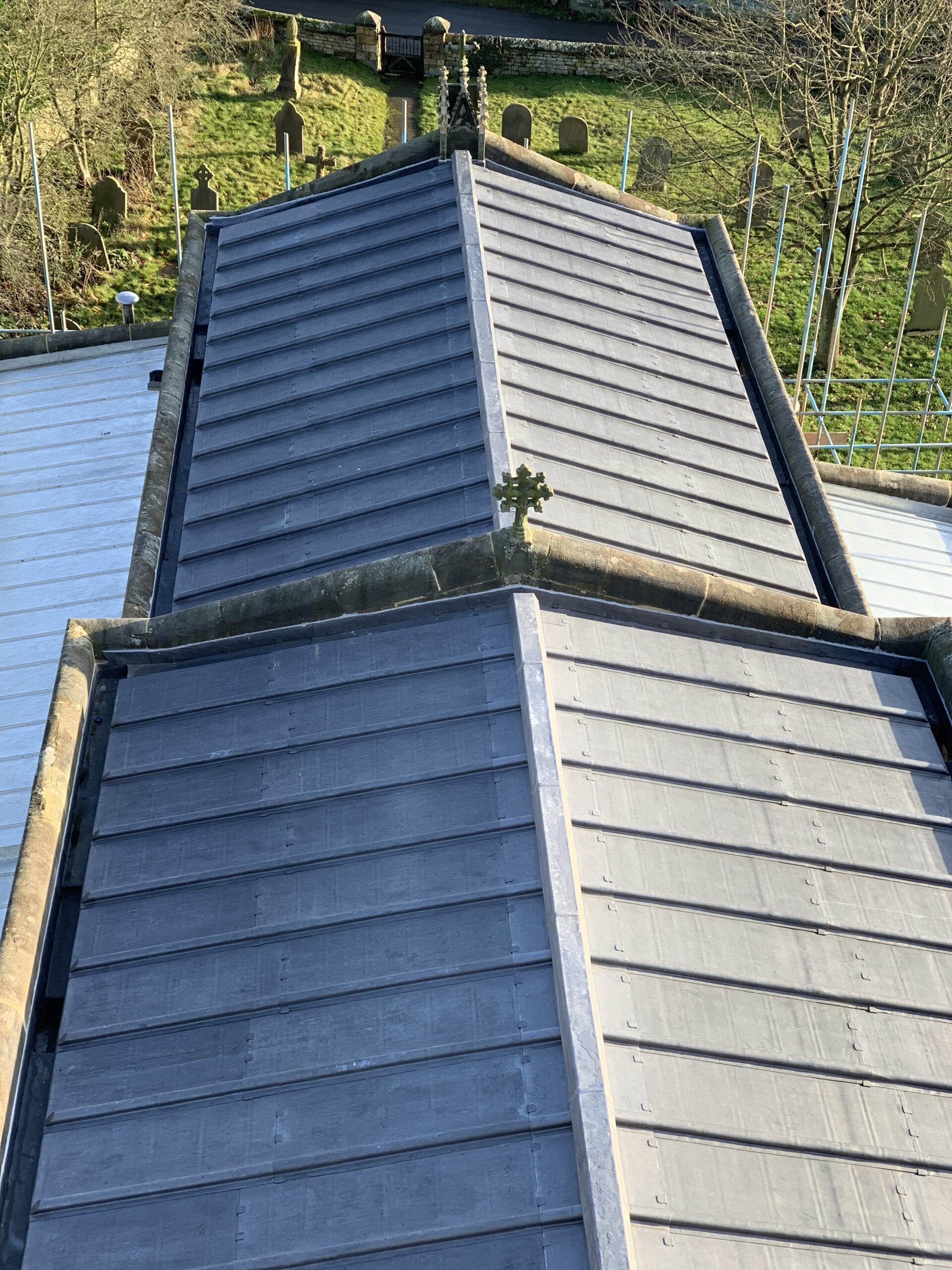
Large public buildings, arenas, transport hubs and historic complexes often discharge vast roof areas into perimeter or parapet gutters. These monumental channels deal with high volumes of water, snow and wind-driven rain. They may sit several storeys above ground and be boxed in by parapets and balustrades, making inspection and repair difficult.
In these situations, code 8 lead offers:
- Extra stiffness to resist deflection and oilcanning in wide, deep troughs.
- Greater mass to cope with snow loading and short-term ponding during intense events.
- A calm, stable surface when seen from adjacent towers or higher buildings.
Design these gutters with the box gutter guide, bay size rules and drainage calculations to keep the heavy sheet within safe working limits.
2) Deep internal box gutters between major roof structures
Internal box gutters that run between two major roof structures—such as nave and aisle roofs, or large portal frames—often carry water from multiple slopes and travel considerable distances before reaching outlets. This makes them prime candidates for code 8 lead, especially where the gutters are concealed within roofscapes or behind parapets.
- Use the Lead Weight Chart to plan bay sizes that remain liftable.
- Position drips, steps and expansion joints over solid, continuous support.
- Coordinate outlets, sumps and emergency overflows with the wider drainage strategy.
3) Deep valley gutters serving multiple roof planes
Some historic and complex modern roofs generate deep valley gutters where several planes meet at different heights and angles. These valleys concentrate large catchment areas into a single trough and may be fed by concealed gutters upstream. In those scenarios, the stiffness and mass of code 8 lead give a valuable performance buffer.
Use the rules in the valley gutters design guide alongside the gauge selection to set widths, upstands and drips that respect both hydraulic performance and material movement.
4) Heritage parapet gutters, cornices and entablatures on tall façades
On tall historic façades, parapet gutters, cornices and entablatures often double as concealed drainage channels. Water may travel along these features for tens of metres before dropping into downpipes, and access for maintenance can be extremely limited. A conservative specification using code 8 lead at these levels provides a long-term safeguard for irreplaceable masonry and plasterwork below.
By combining this heavy gauge with properly detailed joints, drips and overflows, you can create a system that respects the original architecture while significantly improving resilience against water ingress.
5) Cathedral and landmark roofs with high visual and cultural value
Cathedrals, churches, civic halls, theatres and other landmark buildings frequently rely on lead gutters and parapets to protect interiors of very high value. Work in these environments often forms part of long-term conservation programmes and must stand up to scrutiny from conservation bodies, insurers and future surveyors.
Where roof geometry and load paths justify it, using code 8 lead in key gutters and parapet channels offers a specification that aligns with the building’s significance. Bay design, movement joints and substrates must be detailed with particular care, but the resulting assemblies can offer exceptional durability when maintained correctly.
6) “No compromise” gutters above critical plant and technical spaces
In some modern buildings, technical spaces—data centres, control rooms, medical facilities, power distribution arrays—sit directly below roof gutters. Water ingress in these locations could cause severe disruption or safety issues. Where architecture forces deep or complex troughs above such spaces, code 8 lead becomes an attractive “no compromise” option.
Coupled with redundant drainage paths, monitored outlets and robust detailing, this heavy gauge helps minimize the risk of catastrophic leaks in mission-critical environments.
7) Experimental or highly bespoke trough details with complex geometry
From contemporary museums to high-end residential projects, bespoke roof forms sometimes generate troughs with unusual geometry—compound curves, varying depths or changing widths. When those troughs also carry significant water or snow loads, the extra mass and stiffness of code 8 lead can support the design intent while maintaining a robust performance envelope.
These projects demand careful prototyping, mock-ups and sign-off. The gauge choice is one part of a wider design package, but using the heaviest sheet helps ensure that subtle geometry is backed up by serious structural capacity in the metal.
Code 7 vs code 8 lead: which is right for your gutter?
Both code 7 and code 8 lead occupy the top end of the gauge range. The decision between them should be driven by risk, access, catchment and heritage context rather than habit or preference.
- Choose code 7 for deep gutters and valleys where loads are high but access is still feasible and remedial work is practical.
- Choose code 8 lead where gutters are monumental, access is constrained, interiors are uniquely sensitive or heritage value is exceptionally high.
- Use intermediate gauges—code 5 and 6—for many “everyday” trough details that are still demanding but not extreme.
Bay sizing, support design & fixings for extreme gauges
Bay sizing & laps
With code 8 lead, bay sizes are constrained not only by thermal movement but also by manual handling and substrate capacity.
- Start from the bay dimensions recommended in BS 6915 and LSTA guidance for this gauge.
- Use the Lead Weight Chart to validate that each bay remains reasonably liftable.
- Maintain generous head laps and side laps in valleys and box gutters, especially where pitch is low or depth is high.
Support, restraint & underlay
The extra mass of code 8 lead demands robust, continuous support and carefully considered restraint details.
- Ensure substrates are continuous, smooth and designed to carry the self-weight plus water and snow loads.
- Use clips, straps and stainless fixing systems that restrain edges without locking bays rigid.
- Always install the sheet over a suitable lead underlay or building paper to reduce friction and underside abrasion.
Design workflow for monumental gutters & parapets
Because code 8 lead is reserved for high-stakes locations, it helps to run a structured design workflow before you start ordering material:
- Quantify risk: identify which gutters and valleys are above sensitive interiors, heritage features or critical plant.
- Define catchment: calculate contributing roof areas and the likely design flows to each trough.
- Select gauge: use code 8 lead only where the combination of risk, catchment and access justifies it.
- Set geometry: apply rules from the box gutter guide and valley gutter guide to determine widths, depths and upstands.
- Design bays & joints: plan bay lengths, laps, drips and movement zones using BS 6915 and manufacturer guidance.
- Coordinate structure & drainage: confirm that supporting elements and outlet systems are designed around the final layout.
Heritage and cathedral-grade roofing projects
On heritage and cathedral projects, code 8 lead is often discussed in the same breath as structural strategy, stonework conservation and long-term roof access. It is rarely a simple like-for-like swap with lighter sheet; instead, it forms part of a holistic design intent aimed at delivering a century-scale service life where reasonably practicable.
For heritage work:
- Collaborate closely with conservation architects, structural engineers and client teams when selecting code 8 lead.
- Use traditional forms—such as wood-cored rolls and carefully bossed corners—where appropriate to the original architecture.
- Finish exposed surfaces with patination oil to control early run-off staining on stonework and to present a uniform appearance from viewing platforms.
Handling, manual lifting & COSHH for code 8
With sheet masses around 40 kg/m², code 8 lead is not a material that can be moved casually. Safe handling and COSHH controls must sit front and centre in your method statements.
- Pre-cut bays on the ground to dimensions that keep individual pieces within safe manual handling limits.
- Use hoists, cranes and mechanical lifts to bring material to the workface wherever possible.
- Wear gloves, avoid dry brushing and observe hygiene controls to manage exposure risks around lead handling.
- Dispose of offcuts, swarf and contaminated wipes in line with your COSHH for rolled lead sheet procedures.
For further reading on safe practice, see:
Fast ordering workflow with the Shoppable Lead Chart
Once the drawings and bay layouts are pinned down, our Shoppable Lead Chart turns the specification for code 8 lead into a clean, accurate basket in just a few minutes—ideal for busy contractors working on complex schemes.
Select widths and lengths for each bay, cross-check mass via the Lead Weight Chart, then add compatible underlay, fixings and finishing products so everything arrives together on site.
FAQs about code 8 lead
How thick and heavy is code 8 lead?
Code 8 lead is a very heavy gauge, with a nominal thickness of around 3.55 mm and a mass in the region of 40 kg/m², produced within the tolerances set out in BS EN 12588.
Where is code 8 lead most appropriate?
This gauge is most appropriate for monumental gutters, deep parapet gutters, internal box gutters on major roofs, cathedral-grade details and high-risk interfaces where access is constrained and the consequences of leakage are high.
Can I use code 8 lead for ordinary valleys or flashings?
It is technically possible but rarely sensible. For ordinary valleys and flashings, lighter gauges are more practical and still fully compliant when detailed correctly. Reserve code 8 lead for the locations that really justify it.
What underlay should I use beneath this gauge?
Always use a continuous lead underlay or building paper beneath the sheet. This protects the underside, reduces friction and helps accommodate thermal movement without fretting.
How do I order code 8 lead accurately and quickly?
Use the Shoppable Lead Chart to select bay widths and lengths, confirm masses with the Lead Weight Chart, and then add fixings, underlay and patination oil before checkout.