

 Code 3 Lead
 Code 4 Lead
 Code 5 Lead
 Code 6 Lead




Patination Oil: 9 Pro Tips for a Flawless Finish (No Stains) | The Lead Lads Shop


Patination Oil: 9 Pro Tips for a Flawless Finish (No Stains)
Patination oil is the low-effort, high-impact finish that prevents early white carbonate staining on stone and render and evens the first months of weathering on new leadwork. This is the practical guide built by lead workers for lead workers—how patination oil works, exactly when to use it, how to apply it, what to avoid, and how to buy the right product fast.
Want install support instead of DIY? Get a quote via The Lead Lads service pricing or our heritage partner GNR Roofing. For training and best-practice standards, see the Lead Sheet Training Academy.
In this guide
- Why patination oil matters on day one
- What patination oil actually does
- When to apply patination oil
- How to apply patination oil (step-by-step)
- Coverage, conditions & finish expectations
- Detail by detail: aprons, soakers, back gutters & bays
- Common mistakes with patination oil
- Troubleshooting stains & touch-ups
- Buying guide & quick links
- FAQs
- Structured data
Why patination oil matters on day one
New lead is reactive. In the early weeks, rain and condensation can form white carbonate crystals that streak onto stone and render below. The finish looks blotchy, clients worry, and you get callbacks. Applying patination oil the same day you finish the metalwork interrupts that process. The thin film stabilises the surface while the natural patina develops evenly, so the elevation reads “finished” from the first shower onward.
Importantly, patination oil is not a substitute for correct detailing. Short cover, reverse laps and trapped movement will still fail. Think of patination oil as the tidy, preventative final step that protects your reputation—not a magic fix.
What patination oil actually does
- Controls early staining: Patination oil limits carbonate run-off onto stone/render during the first weather cycles.
- Evens initial colour: It reduces the patchy look of fresh lead so the installation appears consistent from day one.
- Protects edges: Drips, welts and arrises where water concentrates benefit most from a careful pass of patination oil.
- Zero structural role: It doesn’t change strength, movement or lifespan; that’s down to code, bay sizing, underlay and workmanship.
For formal training and standard details, the Lead Sheet Training Academy is a trusted authority. If a project requires a specialist, book via The Lead Lads pricing or GNR Roofing.
When to apply patination oil
- Same-day application: After forming and fixing—before dust settles or rain hits. Patination oil works best on clean, dry metal.
- Prioritise visible edges: Aprons over pale render, dormer cheeks, porch abutments, chimney drips and bay edges.
- Finish step: Don’t oil half-done work. Complete forming, fixings and pointing first; oil is the last pass before sign-off.
How to apply patination oil (step-by-step)
- Prep clean: Wipe the lead with a lint-free cloth to remove swarf, dust and hand oils. Patination oil won’t hide dirt—it seals it in.
- Dampen, don’t drown: Load a fresh lint-free cloth lightly. Overloaded cloths cause smears and tide marks.
- Edges first: Run a deliberate pass along drips/welts and upstands where water breaks; this is where staining begins.
- Thin, even film: Use overlapping strokes, keeping a wet edge. Avoid pooling. Patination oil is effective in small amounts.
- Raking-light check: Sight along the surface. Re-pass any dull patches to maintain even sheen.
- Let it cure: Keep the area dry until touch-dry. Avoid rain or aggressive cleaning during the initial cure.
Coverage, conditions & finish expectations
| Topic | Guidance |
|---|---|
| Coverage (planning) | Thin film; a 0.5 L bottle goes further than you think when applied correctly. Prioritise visible faces/edges. |
| Temperature | Apply above ~5 °C. In hot sun, work smaller areas to prevent flash-off streaks with your patination oil. |
| Moisture | Surface must be dry and dust-free. Rain during application risks patching. |
| Appearance | Expect a subtle, evened sheen that settles as natural patina forms. Patination oil is not glossy varnish. |
| Maintenance | No routine re-coat. If desired for looks, wash gently (mild soapy water), dry, then apply a light fresh coat. |
Detail by detail: aprons, soakers, back gutters & bays
Aprons & abutments
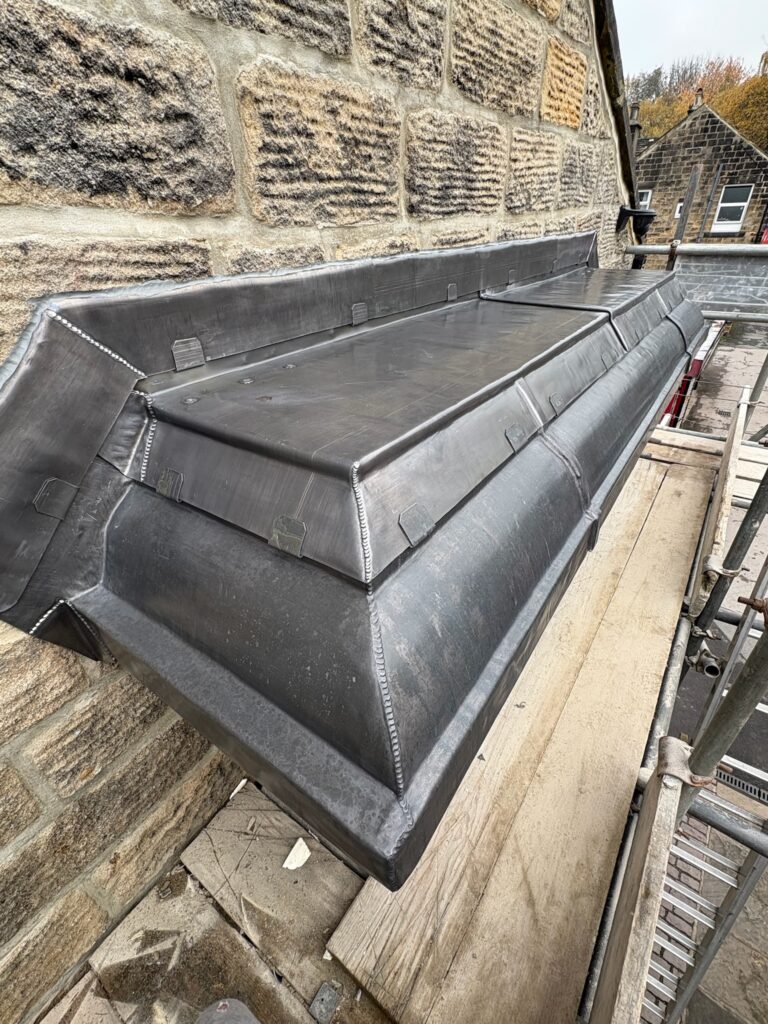
Edges above light render or stone show problems first. After installing and pointing, wipe clean and apply patination oil to the drip/welt, then across the face. Keep the film thin and continuous.
Step soakers
With many small faces, the temptation is to skip. Don’t. A quick pass along each exposed edge with patination oil stops faint white tracks down the wall after showers.
Back gutters
Hydraulic load is higher behind stacks. After hose-testing for leaks, dry the surface, then coat edges and turns carefully with patination oil to avoid early streaks onto stone/render below.
Bay roofs
Focus on bay edges and drips. If the bay is visible from below, patination oil helps the appearance read consistently while the patina develops.
Common mistakes with patination oil
- Applying to wet/dirty lead: Locks in grime and creates permanent streaks.
- Flood-coating: Pools dry patchy and collect dust. Patination oil is a thin-film product.
- Skipping edges: The drip/welt is where staining begins; double-pass here with patination oil.
- Using oil as a fix-all: It won’t correct reverse laps, short cover or trapped movement.
- Touching before cure: Fingerprints and cloth lines appear; let patination oil set undisturbed.
Troubleshooting stains & touch-ups
- Clean down gently: Use clean water and a soft brush on stone/render. Avoid harsh acids/solvents.
- Re-prep the lead: Wipe the metal clean and dry thoroughly.
- Re-apply lightly: A fresh, thin coat of patination oil on the lead, with an extra pass on drips/welts.
- Monitor run-off: First few rains should show reduced/zero streaking if the application is correct.
Buying guide & quick links
One-and-done basket (mobile-first)
- Patination Oil 0.5 L — thin-film finish to prevent early staining.
- Rolled Lead Sheet (BS EN 12588) — codes 3–8 for flashings, back gutters and bays.
- Lead Underlay & Tapes — slip layer for quieter, longer-lasting bays.
- Copper/Stainless Fixings — hold where allowed; let the metal move elsewhere.
- Sealants & Accessories — tidy pointing; don’t “glue” sliding zones.
Prefer an installer? Get quotes via The Lead Lads service pricing or GNR Roofing. For best-practice training, see Lead Sheet Training Academy.
Related internal reading
11 Lead Flashing Mistakes & Fixes Lead Codes Explained (BS EN 12588) Lead for Chimneys Lead for Flat Roofs
FAQs
Is patination oil structural or waterproofing?
No. Patination oil is purely a finishing coat to control early staining and even initial colouring. Weathering integrity comes from correct codes, laps, chases, movement joints and underlay.
Do I need to reapply patination oil later?
Usually not. It’s for the early weathering phase. If a freshen-up is desired for appearance, clean gently, dry, and apply a very light coat of patination oil.
Will patination oil stain stone or render?
Applied thin and even to clean, dry lead, patination oil helps prevent staining. Avoid flooding the surface or dripping onto porous materials below.
Can I use patination oil in the rain or cold?
No. Apply in dry conditions and ideally above ~5 °C. Work smaller sections in hot sun to avoid flash-off marks.
Which products should I buy with patination oil?
Pair patination oil with lead underlay, copper/stainless fixings and, if needed, sealants. Build it quickly with the shoppable lead chart.
Conclusion & buying links
Patination oil is the simplest way to avoid early white staining and hand over tidy, even-looking leadwork. Apply the same day, keep it thin and even, double-pass edges, and you’ll reduce callbacks to near zero. Add a bottle to your kit now and finish every job like a pro.